Kitchen Renovation Cost Toronto: A Contractor's Honest 2026 Guide
April 3, 2026
You want a number? Here it is. A kitchen renovation in Toronto will cost you anywhere from $15,000 for a quick cosmetic update to well over $80,000 for a high-end, custom job. There. The internet has given you a number.
But the number alone won’t protect your budget. The real kitchen renovation cost in Toronto isn’t about one big figure — it’s about a thousand small decisions that either save you money or bleed your account dry. Knowing where the money disappears is the only thing that separates a smart investment from a money pit.
I’m Rob Castillo — Red Seal certified carpenter (that’s Canada’s highest trade credential), Humber College grad, and founder of RC Style Inc. For more than 20 years, I’ve been a general contractor in this city, and I’ve renovated over 200 kitchens across the GTA — from Scarborough semis to Roncesvalles Victorians, Vaughan new builds to downtown condos. I’ve seen it all: the good, the bad, and the budgets that went completely sideways because someone fell in love with a faucet they saw on Instagram.
So forget the vague online calculators for a minute. Let me walk you through what it actually costs, what drives the price, and what separates a kitchen reno you’ll love for 20 years from one that falls apart in five.
1. Kitchen Renovation Cost in Toronto: The Full Breakdown
When someone asks me for a ballpark, I tell them it comes down to three things: the tier of finishes you pick, the size of your kitchen, and how the individual costs shake out.
By Renovation Tier
Most kitchen renovation projects in Toronto fall into one of three buckets. This is the fastest way to understand kitchen renovation cost in Toronto at a glance.
| Tier | Cost Range (CAD) | What You Get |
|---|---|---|
| Budget / Cosmetic | $15,000 – $25,000 | Cabinet refacing or IKEA boxes, laminate countertops, basic appliances, LVP flooring, paint. Same layout. No plumbing or electrical moves. |
| Mid-Range | $25,000 – $50,000 | Semi-custom cabinets, quartz countertops, new appliances, tile backsplash, updated lighting. Minor layout tweaks possible. |
| High-End | $50,000 – $80,000+ | Custom millwork, stone countertops, premium appliances, full electrical and plumbing upgrade, structural changes if needed. The works. |
The $25K–$50K range is where most Toronto homeowners land. That’s your solid mid-range kitchen renovation — the one that adds real value to the home and actually functions well day-to-day.
By Kitchen Size
Size matters more than people think. A galley kitchen reno is a completely different animal from a full open-concept gut job.
- 10x10 kitchen (standard builder kitchen): $15,000 – $30,000
- 12x12 kitchen (average Toronto semi-detached): $25,000 – $45,000
- Galley kitchen (townhouse, condo): $12,000 – $25,000
- Open-concept / large kitchen (300+ sq ft reno area): $60,000+
In terms of cost per square foot, expect $150 to $400 CAD depending on finishes, scope, and whether you’re moving walls or plumbing. A cosmetic refresh sits at the low end; a full gut job with structural changes pushes the higher figure.
Line-by-Line: Where the Money Goes
This is the part that separates honest kitchen renovation ideas from wishful thinking. Understanding the percentages helps you see why a “cheap” quote is often too good to be true.
For a standard 10x12 kitchen in Toronto:
- Cabinets (35–40%): Your single biggest expense. Stock cabinets from a big box store might be $5,000. Semi-custom, maybe $10,000–$15,000. Fully custom millwork from a local shop? You’re looking at $20,000–$25,000, easily. Kitchen cabinets cost is the one line item that makes or breaks the entire budget.
- Labour (20–25%): This is my team — demo crew, installers, electricians, plumbers. Don’t cheap out here. Bad installation ruins even the most expensive cabinets. Budget $7,000–$12,000 for a standard kitchen reno cost in this city.
- Countertops (10–15%): Laminate is cheap ($40/sq ft), quartz is the standard ($80–$120/sq ft), and natural stone goes higher. For an average kitchen, expect $4,000–$7,000.
- Appliances (10%): You can get a full suite for $4,000 or spend $20,000 on a single high-end range. My advice? Spend your money on a good dishwasher and a reliable fridge. Nobody notices a $300 microwave.
- Flooring (5–7%): Luxury Vinyl Plank (LVP) is king right now — durable, waterproof, and looks great. Budget about $2,000–$4,000 installed.
- Everything Else (10%): Backsplash tile, sink, faucet, lighting, paint, and the most important line item: a 10–15% contingency fund for the unexpected. Trust me, there’s always something unexpected. Always.
Total ballpark: For a solid, mid-range kitchen renovation in Toronto in 2026, you should be budgeting $25,000 to $50,000.
Of the last 50 kitchens my team has completed, about 65% landed in that mid-range bracket. The average final cost was $38,000, and the average timeline overrun was about 2 weeks — almost always caused by material delays or discovery of hidden issues behind the walls. Those aren’t generic numbers from a database. That’s my project log.
A note on these numbers: these are estimates based on my experience across 200+ GTA projects. Your actual costs will vary depending on your specific home, neighbourhood, scope, and market conditions at the time of your reno. Always get at least three written quotes before signing anything.
If you want a full scope of what that gets you, check out our full kitchen renovation service.
2. The Timeline: What 6–8 Weeks Actually Looks Like
One of the most common questions I get: “How long will we be without a kitchen?” Here’s the honest answer — it’s longer than you hope but shorter than you fear.
Week-by-Week Breakdown
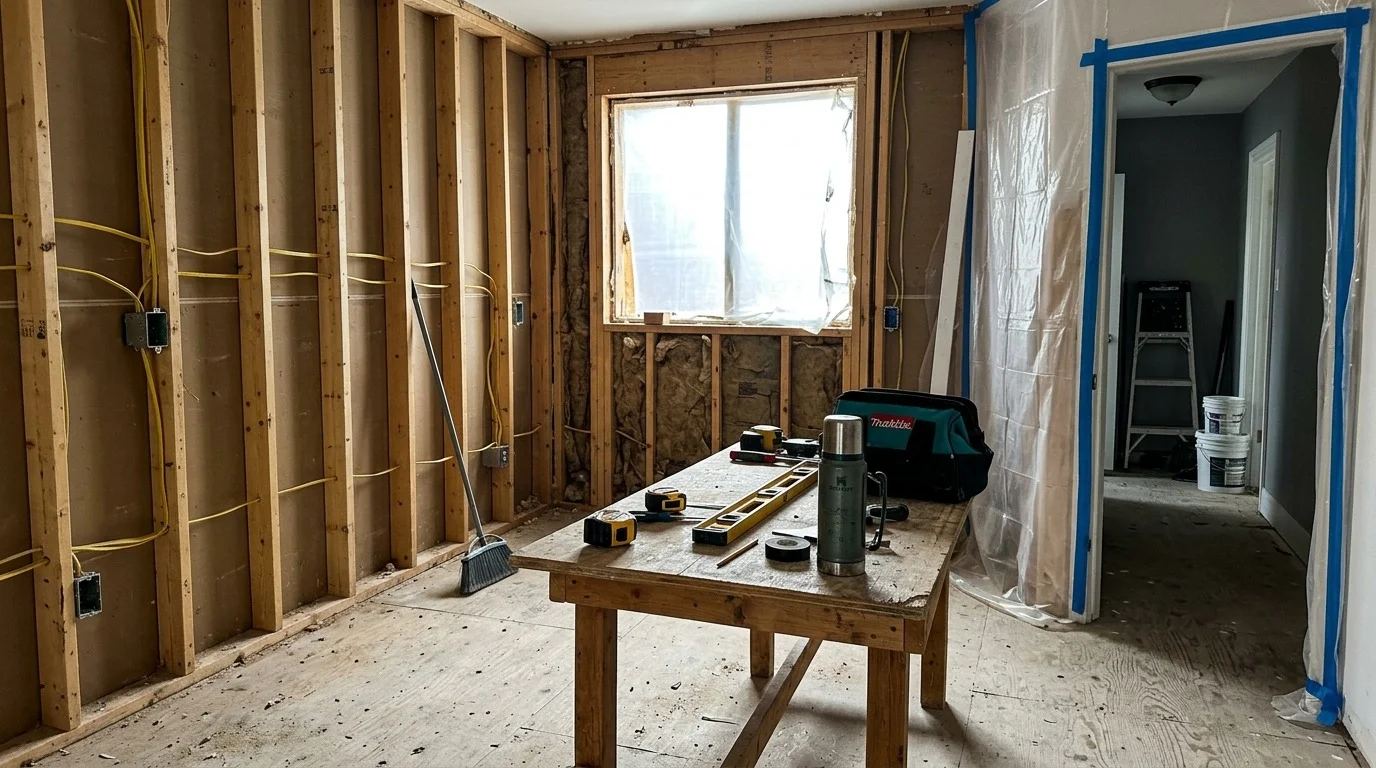
Week 1: Demolition and Rough-ins. It’s loud, it’s dusty, and it’s the week where your house feels like a construction zone because, well, it is. We tear out the old kitchen. Then the plumber and electrician come in for the rough-ins — that’s the plumbing and electrical work done inside the walls before we close them back up. This is when we find the “surprises.” Old knob-and-tube wiring. A pipe that was jury-rigged in 1987 and held together with duct tape and prayer. A load-bearing wall nobody mentioned. This week sets the tone — and it’s what your contingency fund is for.
Week 2–3: Drywall and Paint. We close up the walls, mud, tape, and sand. Then a first coat of paint goes on before the cabinets arrive. This phase is boring but critical — sloppy drywall work will haunt you for the life of the kitchen.
Week 4: Cabinet and Flooring Installation. Your new kitchen starts to take shape. The boxes go on the walls, the new floor goes down. This is the week clients finally start getting excited instead of panicking.
Week 5: Countertop Templating and Fabrication. After the cabinets are in, a specialist comes to make a precise digital template. Then it takes about 5–10 business days to cut the stone. You have no counters during this time. Plan for a lot of takeout.
Week 6: Countertop Installation and Backsplash. The beautiful new counters go in. The tile setter does the backsplash. This is the week that makes clients cry — in a good way.
Week 7: The Finals. Plumber connects the sink and dishwasher. Electrician installs lights, switches, and outlets. Appliances get hooked up. The kitchen becomes a real room again.
Week 8: Finishing Touches and Punch List. Final coat of paint, trim work, cabinet hardware, and a final walkthrough to build the punch list — the little things that need adjusting. Crown moulding gaps, a drawer that’s slightly off level, that kind of thing.
Important caveat: That’s 6–8 weeks of active work time. Add 2–4 weeks of planning, design, and material lead times before we even swing a hammer. Total project calendar is often 10–14 weeks from signed contract to final punch.
3. Kitchen Renovation ROI: Does It Pay Off?
Here’s something most contractors won’t talk about openly: not all kitchen renovations pay you back.
Based on data from Remodeling Magazine’s 2025 Cost vs. Value report and CMHC housing market data, the returns in a Canadian urban market like Toronto look like this:
- Minor kitchen remodel ROI: 72–81%
- Major kitchen remodel ROI: 49–60%
That means if you spend $80,000 on a full custom gut-and-rebuild, you might add $40,000–$48,000 in home value. That’s not nothing — but it’s not dollar-for-dollar either.
The 30% Rule
Here’s the guideline I give every client: don’t spend more than 30% of your home’s current market value on a single kitchen renovation. If your home is worth $900,000 in Toronto (which is pretty average these days), keep your kitchen reno under $270,000. That sounds like a lot, but I’ve seen people put $120,000 into a kitchen in a $700,000 house. They’ll never get that back at resale.
The sweet spot — where you get genuine value plus a return at sale — is in that $25,000 to $50,000 range on a home valued between $700K and $1.2M. That’s the Toronto mid-market, and that’s where renovations make financial sense.
When the ROI Argument Doesn’t Matter
All that said: sometimes ROI isn’t the point. If you’ve lived in the same house for 15 years and you hate your kitchen every single day, fix it. You’ll use that kitchen for another 15 years. That’s quality of life, not an investment spreadsheet.
On a related note, if you’re thinking about tackling a bathroom at the same time — it often makes sense since the trades are already on site — take a look at our bathroom remodel guide for the same level of detail. And if the basement is on the list too, our basement renovation guide covers what to expect down there.
4. Top 5 Mistakes I See Homeowners Make
In 20 years of doing this, the same mistakes show up over and over. Avoid these and you’ll save yourself thousands.
Changing your mind mid-project. Deciding you want the fridge on the other wall after the electrical is done costs a fortune. I had one client change the island layout three times. The second change alone cost her $4,200 in re-work — new plumbing runs, new electrical, a wasted day of labour. Finalize your layout before demolition starts. Full stop.
Buying your own materials to “save money.” I once had a client who bought a “great deal” faucet online. It arrived without a key part, wasn’t certified for Canada, and we wasted a full day trying to make it work. Let your contractor source materials. We have supplier accounts, we know what’s reliable, and if something’s wrong we can get a replacement fast.
Living in the dust. I get it — you want to save on renting a place. But living through a kitchen renovation is brutal. The dust gets everywhere, and I mean everywhere. Your clothes, your toothbrush, your lungs. If you can, move out during at least the demolition and drywall phase. Set up a temporary kitchen in the basement with a microwave, coffee maker, and mini-fridge. Your sanity will thank you.
Ignoring the kitchen triangle. The path between your sink, stove, and fridge should be clear and efficient — each leg ideally 4 to 9 feet, with the total triangle perimeter under 26 feet. Don’t stick your fridge in a far-off corner because it looks cool on the floor plan. Function over form. Every time.
Hiring the cheapest guy. If you get three quotes and one is dramatically lower than the others, run. They’re cutting corners somewhere — insurance, skilled labour, quality of materials. You’ll pay for it later. I guarantee it. I’ve fixed too many “cheap” kitchens to count. Check your contractor’s reviews on HomeStars before you sign anything.

5. When to Splurge and When to Save
Not all upgrades are created equal. Here’s where I tell my own clients to put their money — and where to hold back.
Splurge On
- Good drawers. Soft-close, full-extension drawers are a game-changer. You open them 20 times a day. Get the good hardware — you’ll feel the difference every single morning.
- Under-cabinet lighting. Best task lighting you can add. It makes your kitchen feel twice as expensive and it’s genuinely useful when you’re chopping onions at 6 AM.
- The skill of your installer. The best cabinets in the world look cheap if they’re not installed perfectly level and plumb. Pay for an experienced crew. This is not the place to save.
- Ventilation. A proper range hood that actually vents to the outside. Not a recirculating fan that pushes grease back into the room. Your walls, your ceiling, and your lungs will thank you.
Save On
- Fancy cabinet interiors. You don’t need a built-in spice rack for $500. A $30 insert does the exact same job.
- The brand name on your appliances. A reliable mid-range brand often has the same core components as the luxury one with the fancy logo. I’ve had both in my own house. The $3,000 fridge does the same job as the $8,000 one.
- Trendy finishes. That ultra-matte black hardware looks great today. In 5 years you might hate it. Stick with finishes that have some staying power — brushed nickel, satin brass. Skip whatever is on the cover of this month’s design magazine.
6. What Kitchen Renovation Cost in Toronto Actually Reflects in 2026
I want to be specific here because this is the number-one reason people get sticker shock on their quotes.
Toronto has some of the highest labour costs in Canada. A licensed electrician or plumber in the GTA runs $90–$150/hour (you can verify current trade rates through the Ontario College of Trades). That’s not a scam — it’s a reflection of cost of living, insurance, licensing fees, and the actual skill required. A kitchen renovation in Toronto often requires both a licensed electrician and a licensed plumber. Sometimes a gas fitter too.
Then there’s permit costs. A Toronto kitchen renovation that includes electrical or plumbing changes requires a permit. That’s $500–$1,500 depending on scope (the City of Toronto publishes its current permit fee schedule if you want to check). Anyone telling you they’ll skip the permit to save you money is creating a problem you’ll discover when you try to sell the house.
Material costs are also 10–20% higher in the GTA than in smaller Ontario cities. So when you see a kitchen remodel cost from a blog in another province, remember that it doesn’t apply here. Whether you’re in a Victorian in The Annex, a semi in Markham, or a new build in Richmond Hill, these numbers hold pretty firm across the GTA.
Add it up, and the kitchen renovation cost Toronto homeowners actually pay reflects a real labour market and a real material market. Not inflated contractor greed.
7. FAQ: Kitchen Renovation in Toronto
What is the most expensive part of a kitchen remodel?
Cabinetry. Every time. It runs 30–40% of your total budget. The reason is simple: cabinets are mostly custom-built labour, not just a product you pull off a shelf. Even “stock” cabinets need a professional to measure, order correctly, and install. The kitchen cabinets cost is the single biggest swing in your entire budget — it’s where the tier of your reno gets decided.
Can you remodel a kitchen for $50,000 in Toronto?
Yes, absolutely. A $50,000 budget is a solid mid-range kitchen renovation in Toronto in 2026. You’ll get semi-custom cabinets, quartz countertops, a decent appliance package, new flooring, proper lighting, and updated plumbing fixtures. What you won’t get is a fully custom, move-every-wall, new-electrical-panel gut job — but for most homes, you don’t need that.
How long does a kitchen renovation take?
For a standard kitchen renovation in Toronto, budget 10–14 weeks total from first meeting to final walkthrough. Active construction is typically 6–8 weeks. The gap is lead times on materials, permit approvals, and scheduling trades. The more custom your choices, the longer it takes.
What is the 30% rule for kitchen renovation?
The 30% rule is a general guideline: your total renovation spending across all rooms shouldn’t exceed about 30% of your home’s market value. For the kitchen specifically, most advisors (myself included) recommend keeping it to 5–15% of your home’s value. On a $900,000 Toronto home, that means a kitchen budget of $45,000–$135,000. It’s not a law — but it’s a good reality check to avoid over-improving for your neighbourhood.
What are the biggest kitchen renovation mistakes?
In my experience: changing your layout mid-project, skipping the contingency budget (always set aside 10–15% for surprises), going cheap on installation labour, and ignoring the workflow triangle. If I had to pick one: don’t change the plan after demo starts. That single mistake has cost my clients more money than almost anything else I’ve seen.
Do I need a permit for a kitchen renovation in Toronto?
If you’re moving plumbing, upgrading electrical, or making structural changes — yes, you need a permit. This is a firm requirement in Toronto, and the penalties for unpermitted work aren’t worth the risk. A licensed contractor will pull the permit for you as part of the job. If your contractor suggests skipping the permit, that’s your cue to find a different contractor.
What’s the difference between a kitchen renovation and a kitchen remodel?
In practice, people use these interchangeably — and that’s fine. If I’m drawing a distinction: “remodel” usually implies changing the layout or structure; “renovation” usually means refreshing within the existing footprint. But I care more about the scope of work than the word you use to describe it. Are you moving walls and plumbing? That’s a bigger job with a bigger price tag.
Should I renovate my kitchen before selling?
Depends. If the kitchen is genuinely dated and it’s going to drag your sale price down, a focused cosmetic update makes sense. But don’t do a full custom gut job to sell — the ROI just isn’t there. The sweet spot is a cosmetic refresh: paint the cabinets, new hardware, new countertops if they’re terrible. Keep it under $20,000 and focus on clean and functional over custom and impressive.
How much does a kitchen renovation cost in Canada?
Across Canada, a mid-range kitchen renovation runs $25,000–$60,000 CAD. Toronto and Vancouver sit at the top end of that range because of higher labour costs and material pricing. If you’re in a smaller city — say Edmonton, Halifax, or Winnipeg — you might save 15–25% on equivalent scope. But the core cost drivers (cabinets, labour, countertops) are the same everywhere. The difference is in the hourly rates and the local permit fees.
How much should you budget for a kitchen remodel in 2026?
For Toronto in 2026, I’d tell you to budget $25,000–$50,000 for a solid mid-range kitchen. That gets you semi-custom cabinets, quartz countertops, a decent appliance package, new flooring, and updated lighting. Then add 10–15% on top as a contingency — because there’s always something you didn’t expect behind those walls. If you’re doing a full gut with structural changes, start your planning at $60,000+.
How much do kitchen cabinets cost per linear foot?
In Toronto, stock cabinets run about $100–$200 per linear foot installed. Semi-custom bumps that to $200–$400 per linear foot. Fully custom millwork? $400–$800+ per linear foot. A typical Toronto kitchen has about 20 linear feet of cabinetry, which means your cabinet bill alone could range from $2,000 (stock, small kitchen) to $16,000+ (custom, full kitchen). That’s why cabinets eat 35–40% of the budget.
Stock vs semi-custom vs custom cabinets: what’s the difference?
Stock cabinets come in fixed sizes off the shelf — cheapest, fastest delivery (2–4 weeks), but limited finish and size options. Semi-custom start from a standard base but let you choose finishes, modify sizes, and pick hardware. Lead time is 4–8 weeks. Custom cabinets are built from scratch to your exact specifications by a millwork shop — most expensive, longest lead time (8–14 weeks), but they fit your space perfectly and you control every detail. For most Toronto kitchens, semi-custom is the sweet spot.
What kitchen upgrades have the best resale value?
In order of ROI based on what I’ve seen sell houses in this market: new countertops (especially quartz — buyers notice immediately), cabinet refacing or replacement, updated lighting (especially under-cabinet and pendants), modern hardware (pulls and knobs are cheap but visible), and a quality backsplash. These are the changes that photograph well, show well at open houses, and make buyers feel like the kitchen is “done.” Skip the $20,000 appliance package if you’re renovating to sell.
What kitchen design elements are trending in 2026?
What I’m seeing in Toronto right now: warm wood tones are replacing the all-white kitchen look (finally). Integrated appliance panels that hide the fridge behind cabinet doors. Thin-profile countertop edges instead of the thick waterfall slabs. Statement range hoods as the focal point. And mixed metal hardware — brushed gold handles with matte black fixtures, for example. The overall trend is moving toward kitchens that feel like living spaces, not sterile showrooms. My advice? Pick one trend you love and keep the rest classic. Trends change; cabinets don’t.
A kitchen renovation is a major undertaking, but when it’s done right, it’s also one of the most rewarding things you can do in a home. It’s the room where you start your day, where you feed your family, where you pour a glass of wine at the end of a long one. Getting it right matters.
If you’re in the early planning stage, reach out. I offer a free 30-minute consultation to walk through your space, your budget, and what’s actually realistic. No commitment, no sales pitch — just a conversation between you and a guy who’s done this 200 times. Visit our services page to get started.
Planning a bigger project? My house renovation cost overview breaks down the full picture — room-by-room comparisons, what pre-1960 homes really cost, and how to budget the whole thing.
Got Questions About Your Project?
I'm always happy to chat about renovation plans. No obligation, no sales pitch.
Get in Touch